
South Africa Lacks Dedicated Security Risk Assessor Training
Security Risk Assessor Training remains one of the most overlooked gaps in the security industry, despite its importance to effective protection. While many assume security risk assessment is adequately covered through general security or risk management programs, the reality is very different. The discipline requires specialized knowledge, practical experience, and investigative skills that are not addressed through conventional training. This article explores why dedicated Security Risk Assessor Training is essential, why this gap matters, and what competencies are needed to conduct meaningful and effective physical security risk assessments.
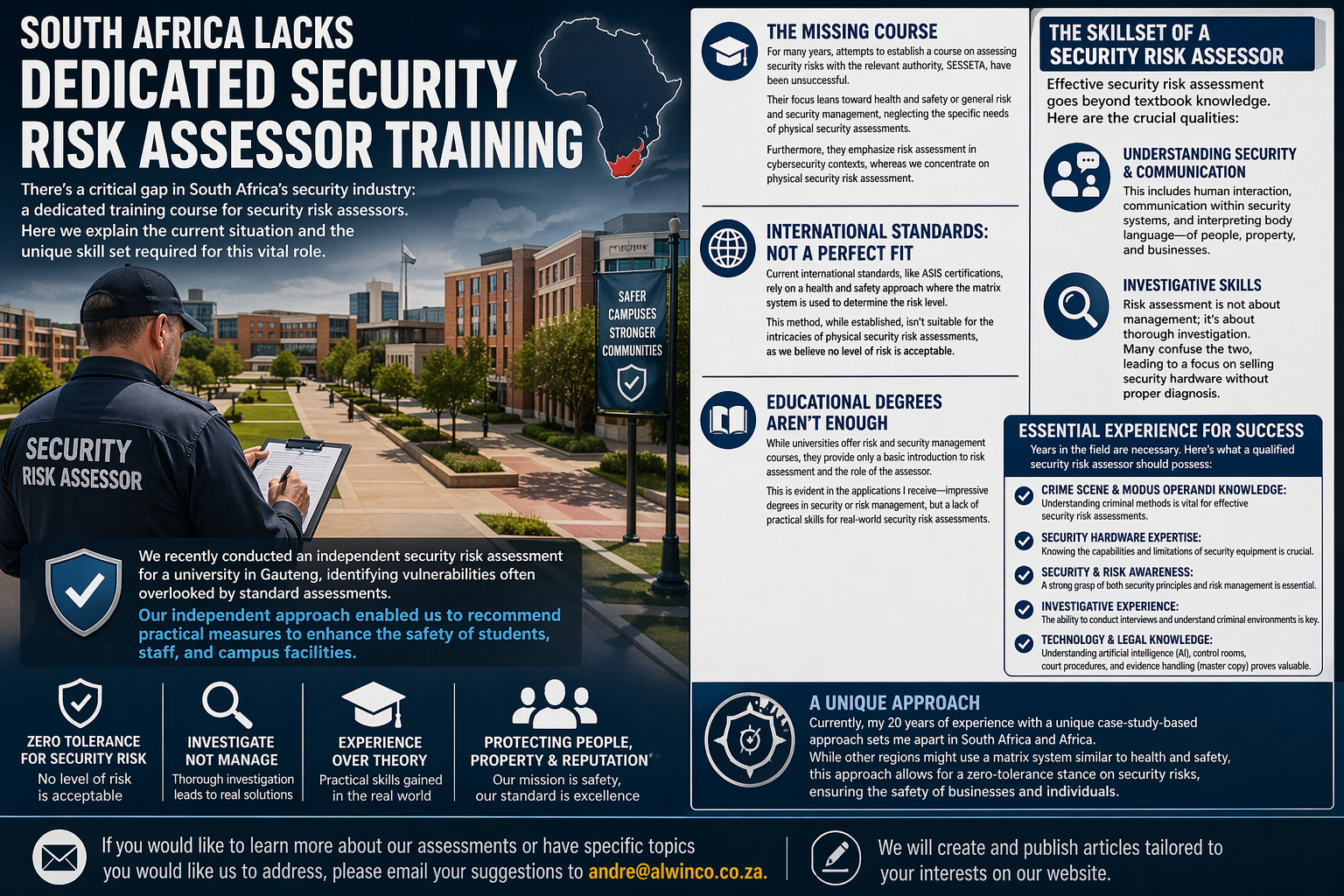
There’s a critical gap in South Africa’s security industry: a dedicated training course for security risk assessors. Here we explain the current situation and the unique skill set required for this vital role.
We recently conducted an independent security risk assessment for a university in Gauteng, identifying vulnerabilities often overlooked by standard assessments. Our independent approach enabled us to recommend practical measures to enhance the safety of students, staff, and campus facilities.
If you would like to learn more about our assessments or have specific topics you ‘d like us to address, please email your suggestions to andre@alwinco.co.za. We will create and publish articles tailored to your interests on our website.
The Missing Course
For many years, attempts to establish a course on assessing security risks with the relevant authority, SESSETA, have been unsuccessful. Their focus leans toward health and safety or general risk and security management, neglecting the specific needs of physical security assessments. Furthermore, they emphasize risk assessment in cybersecurity contexts, whereas we concentrate on physical security risk assessment. We are currently working to change this mindset, and it may be some time before we can establish unit standards for security risk assessments.
International Standards: Not a Perfect Fit
Current international standards, like ASIS certifications, rely on a health and safety approach that uses the matrix system to determine the risk level. This method, while established, isn’t

suitable for the intricacies of physical security risk assessments, as we believe no level of risk is acceptable.
Educational Degrees Aren’t Enough
While universities offer risk and security management courses, they provide only a basic introduction to risk assessment and the role of the assessor. This gap is evident in the applications I receive—impressive degrees in security or risk management, but a lack of practical skills for real-world security risk assessments.
The Skillset of a Security Risk Assessor
Effective security risk assessment goes beyond textbook knowledge. Here are the crucial qualities:
- Understanding Security & Communication: This includes human interaction, communication within security systems, and interpreting body language—of people, property, and businesses.
- Investigative Skills: Risk assessment is not about management; it’s about thorough investigation. Many confuse the two, leading to a focus on selling security hardware without proper diagnosis.
Essential Experience for Success
Years in the field are necessary. Here’s what a qualified security risk assessor should possess:
- Crime Scene & Modus Operandi Knowledge: Understanding criminal methods is vital for effective security risk assessments.
- Security Hardware Expertise: Knowing the capabilities and limitations of security equipment is crucial.
- Security & Risk Awareness: A strong grasp of both security principles and risk management is essential.
- Investigative Experience: The ability to conduct interviews and understand criminal environments is key.
- Technology & Legal Knowledge: Understanding artificial intelligence (AI), control rooms, court procedures, and evidence handling (master copy) proves valuable.
A Unique Approach
Currently, my 20 years of experience with a unique case-study-based approach set me apart in South Africa and Africa. While other regions might use a matrix system similar to health and safety, this approach allows for a zero-tolerance stance on security risks, ensuring the safety of businesses and individuals.
Newsletter subscription
Should you wish to learn more about our services offered or want more information on security risk assessments, please send us an email or kindly visit our website’s security meetings and subscribe to our Newsletter.
This article by Andre Mundell, Independent Security Risk Assessor at Alwinco, highlights the current gap in training for security risk assessors and the essential skills required to excel in this critical role.
Security Risk Assessor Training AI Security Risk Assessor AI
Throughout South Africa, Alwinco performs security risk assessments, boasting a strong presence in Gauteng regions such as Moot, Fourways, Midrand, Rivonia, and Centurion, in addition to Bloemfontein, Bluff, and Cape Province.